For the last two years, most business AI projects hit the same wall: the model was smart, but it was blind. A chatbot could write a great email, but it couldn't check your inventory. A copilot could summarize a meeting, but it couldn't actually update the CRM afterward. Every time a business wanted its AI to do something in a real system, an engineering team had to build a custom, one-off integration expensive, fragile, and impossible to scale across dozens of tools.
Model Context Protocol (MCP) is the open standard that broke that wall down, and 2026 is the year it stopped being a developer curiosity and became core AI infrastructure for real businesses.
What Is Model Context Protocol (MCP)?
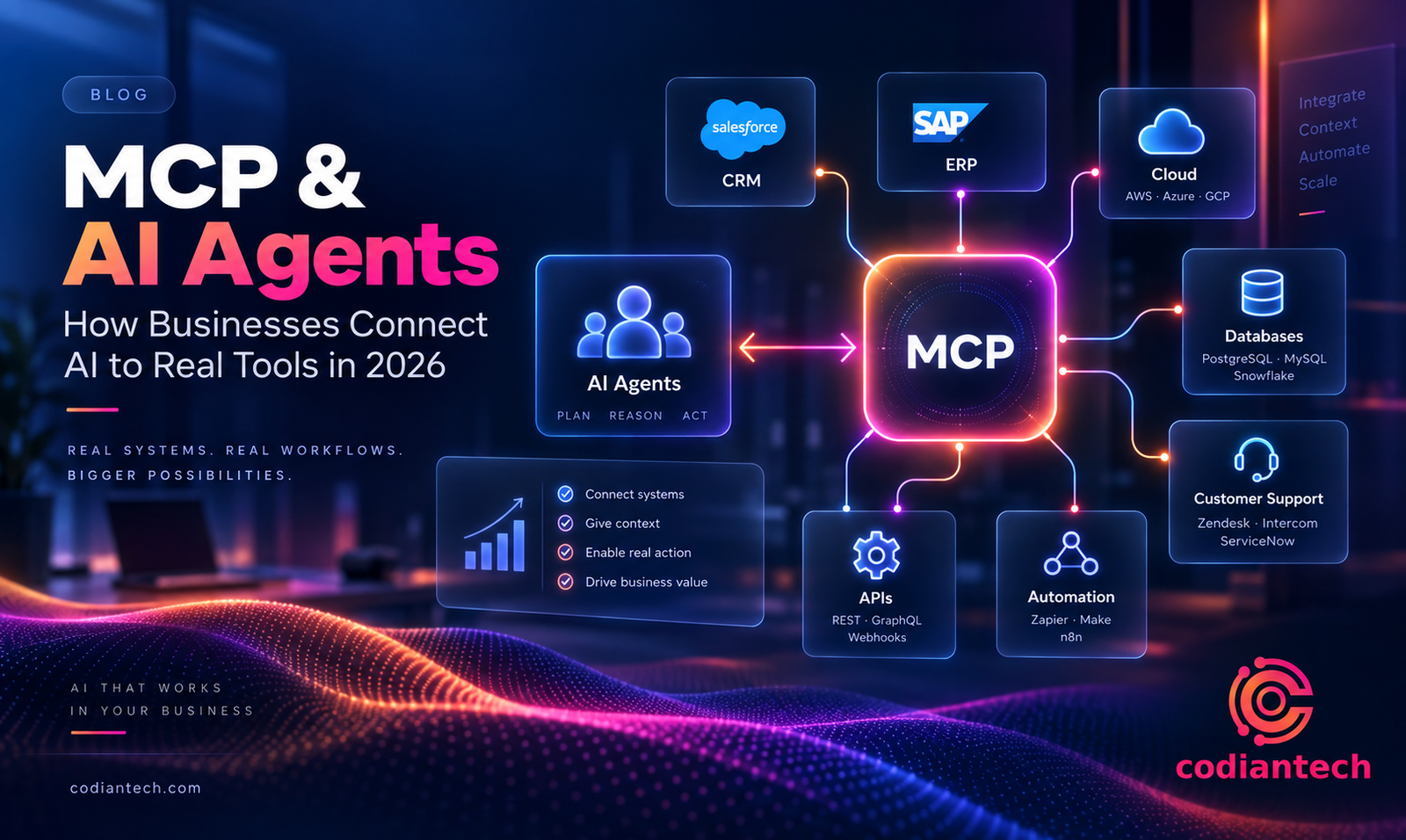
Model Context Protocol is an open standard that gives AI agents a universal way to discover and connect to external tools, data sources, and business systems CRMs, ERPs, internal APIs, databases, ticketing systems, and more — without a custom integration for every single connection.
Think of it like a universal charging port for AI. Before a shared standard, every device needed its own cable. MCP plays the same role for AI agent integration: build an MCP server once for a system (say, your CRM), and any MCP-compatible AI agent whether it's built on Claude, GPT, Gemini, or an internal model can discover it and use it safely, with proper authentication and permissions built in.
That's the core shift: MCP turns AI from a system that only talks about your business into a system that can act inside your business which is exactly the shift CodianTech's AI and Intelligent Automation team helps clients design for.
Why 2026 Is the Tipping Point for MCP Adoption
MCP wasn't always mainstream. It launched in late 2024 as an Anthropic-led open standard, and adoption in year one was mostly limited to developer tools and early AI-native startups experimenting with agent orchestration.
2026 changed that, and the numbers tell the story:
-
The MCP developer toolkit went from roughly 100,000 monthly downloads at launch to tens of millions of monthly downloads within about eighteen months one of the fastest adoption curves any developer infrastructure standard has seen.
-
Enterprise AI teams have moved from pilots to production. Surveys of larger AI teams now show a majority running at least one MCP-backed agent live in production, roughly double the share reporting the same a year earlier.
-
Every major AI provider and a long list of enterprise software vendors have shipped native MCP support, turning it from "an Anthropic thing" into a shared industry layer that OpenAI, Google, Microsoft, and enterprise platforms all build on.
In practical terms, this means MCP has crossed from "interesting standard to watch" into "the default way AI agent integration gets built" much the way REST APIs or OAuth became assumed infrastructure rather than optional add-ons.
How Businesses Are Actually Using MCP and AI Agents
The most valuable MCP implementations aren't flashy demos they're quiet, high-frequency workflow automation running inside systems businesses already depend on.
Customer support and CRM automation. Support agents built on MCP can pull a live customer record, order history, and open tickets from the CRM in one conversation, then update that same CRM automatically once the issue is resolved — no copy-pasting between tools, no stale data.
ERP and inventory workflows. Instead of a human checking stock levels, generating a purchase order, and logging it manually, an MCP-connected AI agent can check inventory, flag reorder points, and kick off the purchase order workflow directly inside the ERP the kind of custom ERP integration CodianTech builds through its Web and Application Development team on platforms like ERPNext and Odoo.
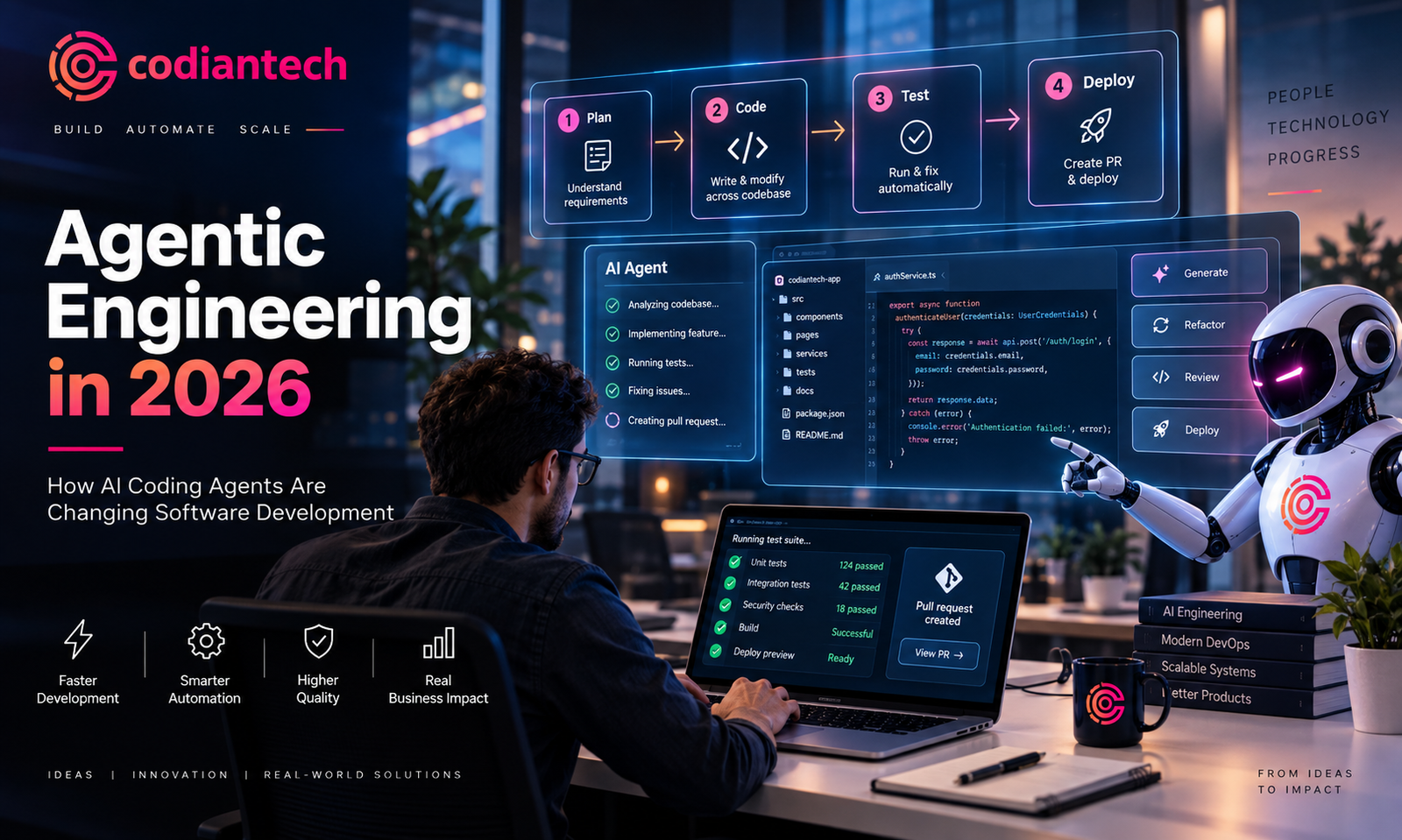
DevOps and AIOps. Engineering teams are connecting MCP servers to CI/CD pipelines, monitoring dashboards, and incident tools, letting AI agents triage alerts, pull relevant logs, and even open a fix pull request a natural extension of the AIOps and DevOps automation work covered under CodianTech's IT Automation and Managed Services.
Multi-agent systems. Because MCP standardizes how agents discover tools, it's also become the connective layer for multi-agent systems one agent handling research, another handling data retrieval, another executing the action — all speaking the same protocol instead of needing custom glue code between every pair.
Sales and marketing copilots. AI copilots embedded in sales workflows use MCP to pull pipeline data, enrich lead records, and trigger outreach sequences directly from natural-language requests, cutting the manual busywork out of day-to-day CRM upkeep.
Ecommerce and mobile experiences. Retailers are wiring MCP-connected agents into storefronts and apps to check stock, apply promotions, and answer order questions in real time work that sits squarely inside CodianTech's E-commerce Solutions and Mobile App Development services.
What Businesses Need to Get Right
MCP removes the integration bottleneck, but it doesn't remove the need for good architecture. Businesses adopting MCP-based AI agent integration in 2026 need to think through:
-
Authentication and permissions. Every MCP server needs clear rules about what data an agent can read and what actions it's allowed to take not blanket access.
-
Governance and auditability. Enterprise teams need to log what an agent did and why, especially in regulated industries like finance and healthcare.
-
Vendor lock-in reduction. One of MCP's biggest advantages is that it's an open standard, not a proprietary connector — done right, it should reduce dependency on any single AI vendor rather than deepen it.
-
Reliability at scale. A single MCP server handling a demo is easy; a production environment with dozens of MCP servers across CRM, ERP, support, and internal tools needs proper monitoring, versioning, and fallback handling.
This is where the gap shows up for most businesses: the protocol is open and well-documented, but building secure, production-grade MCP servers around real business systems and the agent orchestration layer on top of them is still a genuine engineering project. Many teams close that gap by bringing in dedicated engineers through IT Staff Augmentation rather than pulling their core product team off roadmap, and by designing the agent-facing interfaces themselves through a proper UI/UX Design process so employees and customers actually trust what the agent is doing.
How CodianTech Helps Businesses Build on MCP
This is exactly the kind of work CodianTech's AI and Intelligent Automation team builds day to day. As a full-service software agency working with clients across the USA, UK, Europe, and Saudi Arabia, CodianTech designs and deploys the AI agent integration layer that connects large language models to the systems a business already runs on — CRMs, ERPs, internal APIs, and custom workflow tools.
That includes:
-
Building secure, production-ready MCP servers around existing business systems
-
Designing multi-agent workflows for support, sales, and operations teams
-
Integrating AI copilots into CRM and ERP platforms (including custom ERPNext and Odoo environments)
-
Pairing AI automation with CodianTech's DevOps and AIOps services for monitoring and reliability at scale
-
Advising on governance, permissions, and data security for enterprise AI agent deployments
Businesses that treat MCP and AI agent integration as a real infrastructure investment in 2026 not a side experiment are the ones positioned to move faster than competitors still stitching together one-off integrations by hand.
Ready to connect your AI agents to the tools your business actually runs on? Talk to CodianTech's AI automation team about building a secure, production-ready MCP integration for your business.


Comments (0)