Shopify built an empire on a simple promise: you shouldn't need an engineering team to sell things online. For most merchants, that promise still holds. But every year, a predictable group of fast-growing brands hits the same wall the platform that got them from zero to a few million in revenue starts actively working against them at scale.
This isn't a "Shopify is bad" post. Shopify is excellent at what it's built for. This is about recognizing the point where off-the-shelf e-commerce stops working and a custom e-commerce platform or a hybrid, headless approach becomes the better bet.
Why Shopify Wins Early
Before getting into the limitations, it's worth being honest about why Shopify (and Shopify Plus) dominates the first phase of most e-commerce businesses:
-
Speed to launch : a store can go live in days, not months
-
Low upfront cost : no infrastructure, no dev team required to start
-
App ecosystem : thousands of plugins cover common needs without custom code
-
Managed infrastructure : hosting, PCI compliance, and uptime are Shopify's problem, not yours
-
Predictable checkout : Shopify's checkout converts well and is a known quantity for shoppers
If you're validating a product, running a single storefront, or don't have complex backend requirements, this is very hard to beat with a custom build. Even at this stage, a proper Shopify Plus development partner can stretch the platform much further than a default theme setup before you ever need to consider migrating off it.
Where Off-the-Shelf Starts to Break Down
The pattern we see most often at Codiantech, working with growing merchants across the US, UK, EU, and Saudi markets, is that Shopify Plus limitations show up in a handful of recurring places:
1. The storefront looks like everyone else's
Theme customization only goes so far before you're fighting Liquid templates and app-injected scripts just to make a page feel distinctive. Brands that depend heavily on visual storytelling or unconventional UX often hit a ceiling here first this is usually where custom UI/UX design and CRO work starts paying for itself.
2. Checkout and business logic get boxed in
Shopify's checkout is famously locked down (even more so than a few years ago). Custom pricing logic, complex bundling, subscription hybrids, B2B tiered pricing, or non-standard payment flows often require awkward app stacking rather than clean native logic.
3. App bloat becomes a performance and cost problem
Every extra feature is another app, another script tag, another monthly fee, and another point of failure. Merchants running 20–40 apps aren't unusual and each one adds page weight, slows load times, and increases the surface area for something to break during a sale.
4. Multi-entity, multi-region complexity
Selling across the US, UK, EU, and Middle East simultaneously different currencies, tax regimes, inventory pools, languages, and payment methods pushes past what Shopify's native architecture handles gracefully, even on Plus.
5. Data ownership and integration depth
Deep ERP, CRM, or custom fulfillment integrations are possible on Shopify, but they're built around Shopify's API constraints and rate limits not designed around your business logic. At scale, that's backwards. This is typically where custom API and backend integration work becomes the deciding factor.
6. You're paying an increasing "platform tax"
Between Shopify Plus fees, transaction fees (if not using Shopify Payments), and the accumulating app subscriptions, the platform's costs scale with your revenue sometimes faster than they should.
None of these are dealbreakers individually. Together, they're the signal that a business has outgrown a SaaS e-commerce platform and is ready to evaluate custom e-commerce development or a headless architecture.
What "Custom E-Commerce" Actually Means in 2026
"Custom" doesn't have to mean building everything from scratch and for most brands, it shouldn't. The realistic options today sit on a spectrum:
Headless commerce
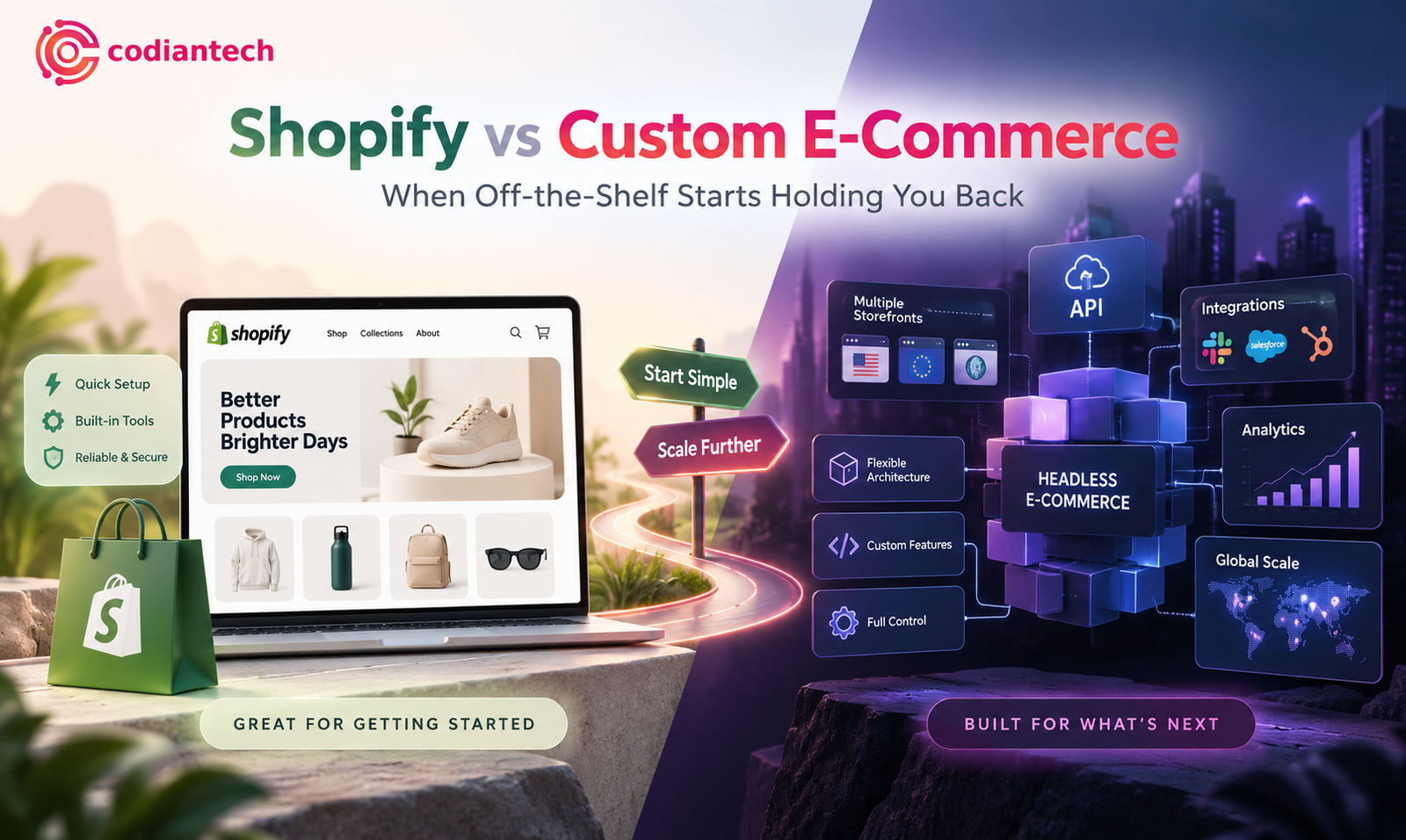
Keep a commerce engine (which can even still be Shopify, via Shopify's headless/Hydrogen approach, or an alternative like commercetools, BigCommerce, or Medusa) but decouple the frontend. This buys full design freedom and performance control while keeping backend commerce logic managed. See our headless commerce development work for examples of this in practice.
Composable commerce
Assemble best-of-breed services a checkout provider, a CMS, a search/discovery layer, a subscription engine into one stack, tied together with custom integration logic. More control per component, more integration work upfront.
Fully custom platform
Build the commerce engine itself. This is rare and usually reserved for very large, unusually complex businesses (marketplaces, highly regulated industries, extremely custom pricing/inventory logic) where no combination of existing tools fits.
For the vast majority of merchants outgrowing Shopify, headless or composable commerce — not a fully custom platform is the right target. It's the pragmatic middle ground: you keep the parts of the SaaS ecosystem that work, and replace the parts that are actively constraining growth.
A Simple Way to Decide
Ask three questions:
-
Is the limitation about design/UX, or about business logic?
Design constraints often just need a better theme or a headless frontend. Business-logic constraints (pricing, inventory, multi-entity operations) usually need deeper architectural change.
-
Is app bloat costing you conversion?
If page speed, checkout friction, or reliability during peak traffic are measurably hurting revenue, that's a stronger signal than "the CEO wants a slicker homepage."
-
What's the real cost of staying vs. migrating?
Migration has real cost and risk. It's only worth it when the ongoing platform tax in fees, dev workarounds, and lost conversion clearly exceeds it over a 12–24 month horizon.
If two or three of these point the same direction, it's time to scope a Shopify migration or headless rebuild seriously rather than adding another app.
How Codiantech Helps
We treat this as an architecture decision, not a sales pitch for "always go custom" plenty of the brands we work with are best served by squeezing more out of Shopify rather than leaving it. Here's what that process typically looks like with us:
1. Platform audit
We review your current storefront, app stack, checkout flow, and integrations to find out exactly which limitations are real bottlenecks versus which are workarounds waiting to be built. This is where most of the "should we migrate?" question actually gets answered.
2. Architecture recommendation
Based on the audit, we scope the right fit optimized Shopify Plus, headless Shopify, or a different commerce engine entirely with a realistic cost and timeline, not just the option that's most interesting to build.
3. Build and migration
Our custom e-commerce development and headless commerce teams handle the rebuild or migration itself, including data migration, integration work with your ERP/CRM, and performance optimization timed around your sales calendar, not against it.
4. Design and conversion work
Where the goal is a distinctive storefront rather than a backend overhaul, our UI/UX design and CRO team can often solve the problem without touching the commerce engine at all.
5. Ongoing support
Post-launch, we offer staff augmentation so you can scale your dev capacity up or down without hiring a full in-house team, plus e-commerce SEO to make sure the new architecture doesn't cost you organic visibility during the transition.
If your store is starting to feel like it's fighting you instead of helping you, get in touch for a platform audit before the next big sales season, not during it.



Comments (0)