
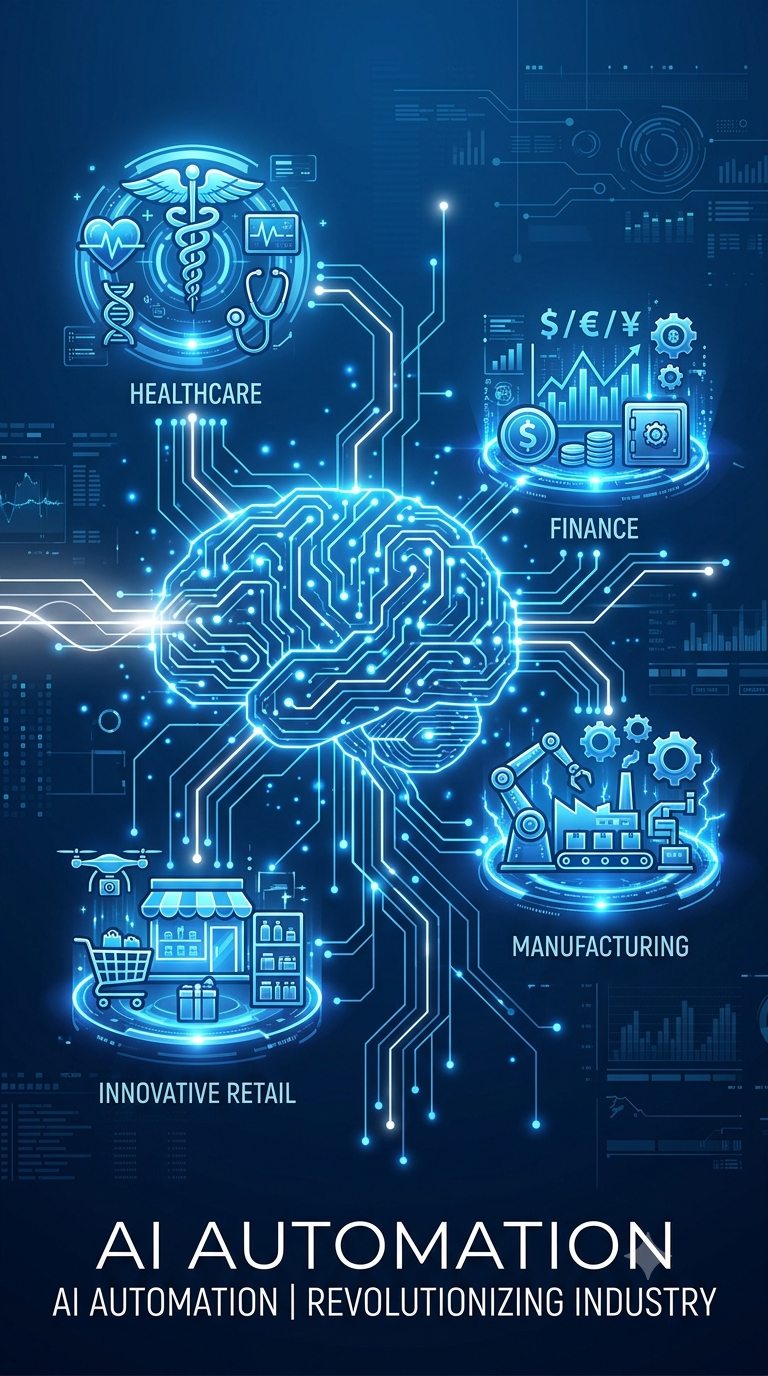
AI Automation Is Changing How Businesses Operate — Here's What You Need to Know
Businesses today are moving faster, dealing with more data, and competing harder than ever. AI automation is becoming one of the most practical tools for keeping up — not because it's trendy, but because it genuinely cuts the time and cost of repetitive, rule-heavy work.
This article breaks down what AI automation is, which industries are using it, what problems it solves, and how your business can start putting it to work.
What Is AI Automation?
AI automation combines artificial intelligence with automated processes. Where traditional automation follows fixed rules ("if X, do Y"), AI-powered automation can learn, adapt, and make decisions based on patterns in data.
Think of it this way: a basic automation tool can send an email when a form is submitted. An AI automation system can analyze thousands of form submissions, identify which leads are most likely to convert, route them accordingly, and even draft a personalized response — all without a human touching it.
The result is smarter workflows, fewer errors, and time freed up for work that actually requires human judgment.
Why Businesses Are Moving Toward AI Automation Now
Several factors have pushed AI automation from "nice to have" to "hard to ignore":
Rising labor costs and talent gaps. Many businesses struggle to hire and retain people for high-volume, repetitive tasks. Automating these tasks reduces pressure on teams and lowers operating costs.
More data than humans can process. Companies generate enormous amounts of data daily. AI systems can analyze that data in real time and act on it, something no manual process can match.
Customer expectations have shifted. People expect faster responses, more personalized experiences, and fewer mistakes. AI automation helps businesses deliver on those expectations consistently.
The tools are now accessible. What required a large engineering team five years ago can now be built, customized, and deployed much faster with modern AI platforms and development partners.
Industries Seeing the Biggest Impact
AI automation isn't limited to tech companies. It's spreading across sectors:
Manufacturing and Supply Chain
Factories use AI to predict equipment failures before they happen, adjust production schedules based on demand forecasts, and flag quality issues on the line. This reduces downtime and waste at scale.
Healthcare
Hospitals and clinics use workflow automation to handle appointment scheduling, insurance verification, and patient follow-up. Clinicians spend less time on admin and more time with patients.
Finance and Banking
Banks apply AI to fraud detection, loan processing, compliance monitoring, and customer support. Tasks that once required teams of analysts now run automatically with high accuracy.
Retail and E-commerce
Retailers use AI automation for inventory management, personalized product recommendations, dynamic pricing, and automated customer service — all processes that run 24/7 without manual input.
Professional Services and SaaS
Law firms, agencies, and SaaS companies automate client onboarding, document generation, reporting, and billing workflows. This makes scaling the business far less labor-intensive.
What Problems Does AI Automation Actually Solve?
It helps when you find your team spending significant time on:
- Data entry and manual reporting — AI can pull, process, and format data automatically.
- Repetitive customer communications — Automated, personalized messages triggered by specific actions.
- Slow approval or review processes — AI can triage, prioritize, and route requests intelligently.
- Human errors in high-volume tasks — Consistent, rule-applied AI processes reduce costly mistakes.
- Scaling without proportionally growing headcount — Automate operations so growth doesn't require doubling staff.
If any of these resonate, your business has a real use case for AI automation.
How to Start Implementing AI Automation in Your Business
Step 1: Identify the right processes first
Not everything should be automated. Focus on tasks that are high-volume, repetitive, clearly defined, and time-consuming. These deliver the fastest return.
Step 2: Map the current workflow
Before building anything, document how the process works today. Where does it start? What decisions are made? Where do delays happen? This mapping is essential before any system is built.
Step 3: Choose the right technology approach
Some businesses use off-the-shelf process automation tools. Others need custom-built AI solutions that integrate with their existing systems. The right choice depends on complexity, scale, and how unique your workflows are.
Step 4: Start small, then expand
Pilot automation on one process. Measure the impact — time saved, error rate reduction, cost change. Use that data to build the case for expanding automation across other parts of the business.
Step 5: Work with a development partner who understands both AI and your industry
The technical side matters, but so does understanding how businesses actually operate. An experienced AI development partner shortens the learning curve significantly.
How Codiantech Helps Businesses Implement AI Automation
At Codiantech, we build custom AI automation systems tailored to how your business actually works.
We don't offer generic software packages. We take time to understand your workflows, identify where automation creates the most value, and build solutions that integrate with your existing tools and data.
Our work spans:
- Custom AI-powered workflow automation for operations-heavy businesses
- Web and mobile applications with AI features built in from the ground up
- Digital transformation projects for companies moving away from manual or legacy processes
- Intelligent process automation that learns and improves from real usage data
Whether you're a startup trying to build an automated onboarding system or an established business looking to cut operational overhead, we build solutions that fit — not workarounds.
We've helped business owners, operations managers, and SaaS founders stop doing by hand what a well-built system can do better and faster.
Ready to Automate the Right Way?
If you've been thinking about where AI automation could fit in your business, the best first step is a clear conversation about your current processes and goals.
Talk to the Codiantech team — we'll help you figure out what's worth automating and how to approach it without overcomplicating things.
6. FAQ SECTION
Frequently Asked Questions About AI Automation
Q1: What is AI automation and how is it different from regular automation? Traditional automation follows fixed, pre-written rules. AI automation adds intelligence — the system can analyze patterns, make decisions, and adapt its behavior based on new data. It handles more complex, variable tasks that rule-based tools can't manage well.
Q2: Which industries benefit most from AI automation? Manufacturing, healthcare, finance, retail, logistics, and professional services all see significant benefits. In general, any industry with high-volume repetitive processes, large data sets, or complex routing and decision-making is a strong candidate.
Q3: Is AI automation only for large enterprises? No. Startups and mid-sized businesses use it effectively. In fact, smaller companies often see a faster return because automating even a few key processes has a meaningful impact on a leaner team. The key is starting with the right process rather than trying to automate everything at once.
Q4: How long does it take to implement an AI automation system? It depends on complexity. A focused automation for a single workflow can be designed and deployed in a few weeks. A larger, multi-system integration project typically takes two to four months. A proper discovery and planning phase at the start makes a significant difference in delivery speed.
Q5: What are the risks of AI automation, and how are they managed? The main risks are building the wrong thing (automating a process that doesn't need it), poor integration with existing systems, and over-reliance without human oversight checkpoints. These are managed through proper scoping, phased rollouts, and building in review points where humans verify outputs before they affect critical decisions.
Q6: How do I know if my business is ready for AI automation? If you have a clear, repeatable process that consumes significant staff time, generates consistent data, and has defined outcomes — you're ready to explore it. You don't need a fully digitized operation to start. Many automation projects also help businesses clean up and structure their data as part of the build.


Login to comment
To post a comment, you must be logged in. Please login. Login
Comments (0)