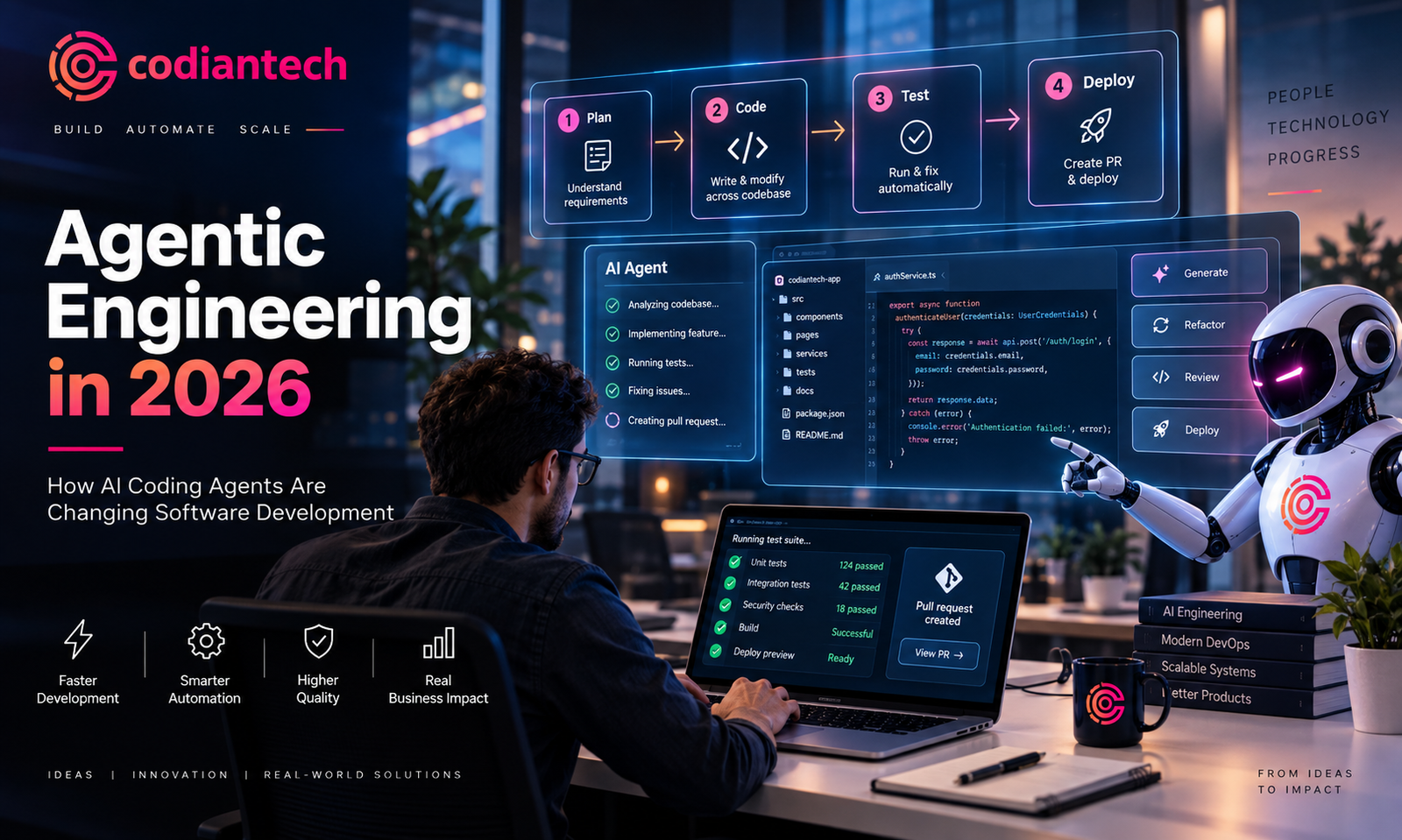
Software development has crossed a threshold. For years, AI tools helped developers write code faster autocomplete on steroids. In 2026, that model has been replaced by something fundamentally different: agentic engineering, where AI coding agents don't just suggest code, they plan tasks, edit across entire codebases, run tests, fix their own failures, and open pull requests with minimal supervision.
At CodianTech, a full-service software development company based in Lisbon and serving clients across the USA, UK, Europe, and Saudi Arabia, we've been tracking this shift closely because it changes not just how software gets built, but how fast and reliably it can be delivered. Here's what's actually happening in agentic software development this year, and how CodianTech is putting it to work.
What Is Agentic Engineering?
Agentic engineering refers to AI-driven development workflows where autonomous coding agents handle multi-step engineering work writing code, running and debugging tests, refactoring across files, and even deploying changes under human oversight rather than human direction at every step. It's the difference between an assistant that answers your questions and an engineer that executes on a brief.
Industry surveys running through mid-2026 show this shift has gone mainstream fast: a large majority of professional developers now use AI coding agents on at least a weekly basis, with a substantial share running them daily as part of their core software development lifecycle. This isn't a minor productivity bump it's a structural change in how custom software gets designed, built, and shipped.
Key Agentic AI Trends Reshaping Software Development in 2026
Multi-Agent Teams Replace Single Assistants
Instead of one general-purpose assistant handling everything, 2026 has seen the rise of specialized, coordinated agent teams one focused on implementation, another on testing, another on code review mirroring how a human software engineering team divides labor. This coordination is central to how modern AI automation services are structured today.
Long-Running Agents Build Complete Systems
Agents are no longer limited to quick, single-turn edits. Many can now work on a task for hours or days, building out complete features from a specification and checking in with human engineers only at key decision points — a pattern increasingly used in enterprise web application development and large-scale platform builds.
Built-In Oversight and AI Code Review
Rather than blindly trusting agent output, modern systems increasingly flag their own uncertainty and use secondary AI reviewers to check the primary agent's work — a layered quality-control approach that mirrors human code review and supports secure, enterprise-ready software delivery.
CLI-First Agentic Workflows
Terminal-based coding agents have proven especially effective across the software development lifecycle because their actions running commands, editing files, executing test suites are easy to verify programmatically. This verifiability is a big reason CLI-first agentic workflows have become a default part of many engineering toolchains, from DevOps pipelines to custom application development.
How CodianTech Uses Agentic AI Across Its Services
CodianTech is technology-agnostic by design, which makes agentic engineering a natural fit across our service lines rather than a bolt-on experiment.
AI and Intelligent Automation at CodianTech
Our AI and Intelligent Automation team builds on the same agentic principles reshaping coding itself — machine learning models, natural language processing, predictive analytics, and intelligent workflow automation that let businesses automate operations end to end, not just accelerate development.
Web and Application Development, Accelerated
Within Web and Application Development, agentic coding tools let our engineers move faster from MVP to production-ready platform across Laravel, the MERN stack, React.js, Node.js, and Python — while keeping architecture decisions and code review firmly in human hands.
DevOps and IT Automation Powered by Agentic Pipelines
Our IT Automation and Managed Services offering pairs agentic coding practices with CI/CD pipelines, GitOps, and infrastructure-as-code using automated agents for testing, monitoring, and deployment tasks that used to eat up engineering hours.
The Changing Role of Developers in the Agentic Era
The role of a software engineer is shifting from "writer of code" to something closer to "director and reviewer of AI-generated work." Developers spend more time on architecture, requirements, and validating agent output, and less time on the mechanical act of typing code line by line a pattern some in the industry call "supervisory engineering." Prompt engineering, agent orchestration, and reviewing AI-authored pull requests are becoming core skills alongside traditional programming ability.
This is precisely why CodianTech's IT Staff Augmentation model pairs pre-vetted developers and DevOps engineers with agentic tooling, giving clients dedicated teams who know how to direct not just use AI coding agents.
Governance, Security, and Responsible AI Coding
Giving an autonomous agent access to a production codebase isn't something to do casually. The organizations getting real value from agentic engineering in 2026 are the ones pairing adoption with governance: clear permission boundaries for what agents can touch, coding standards built into agent instructions, mandatory test coverage before merges, and human approval gates before anything reaches production.
CodianTech applies this same discipline across every engagement, including security-sensitive builds like our government portal and identity-verification projects in Saudi Arabia, where Nafath integration and enterprise-grade access control are non-negotiable.
Why Businesses Choose CodianTech for Agentic Software Development
Agentic engineering delivers speed but only when a team knows how to supervise it properly. That's the model behind every CodianTech engagement, whether it's:
-
Mobile App Development for iOS, Android, and cross-platform apps
-
Complete E-commerce Solutions for Shopify, WooCommerce, and Magento builds
-
Blockchain Development for smart contracts and Web3 platforms
-
UI/UX Design that pairs AI-accelerated development with human-centered design
What's Next for Agentic Engineering
A few things look likely as 2026 continues: agents will keep getting more autonomous on longer, more complex tasks; multi-agent orchestration will become standard practice rather than a novelty; non-technical teams will start using agentic tools directly for internal automation; and security frameworks around agentic coding will keep maturing as the technology's reach expands.
Partner with CodianTech for Agentic-Ready Software Development
Agentic engineering isn't a future trend to watch it's already reshaping how software gets built. If you're exploring how AI coding agents can speed up your next web, mobile, or automation project without compromising on quality or security, start a project with CodianTechand talk through your requirements with our team.

Login to comment
To post a comment, you must be logged in. Please login. Login
Comments (0)