The Future of AI in Home-Based Care: Clinical Workflows, Predictive Analytics, and AI Agents
How Artificial Intelligence Is Transforming Home Healthcare Operations
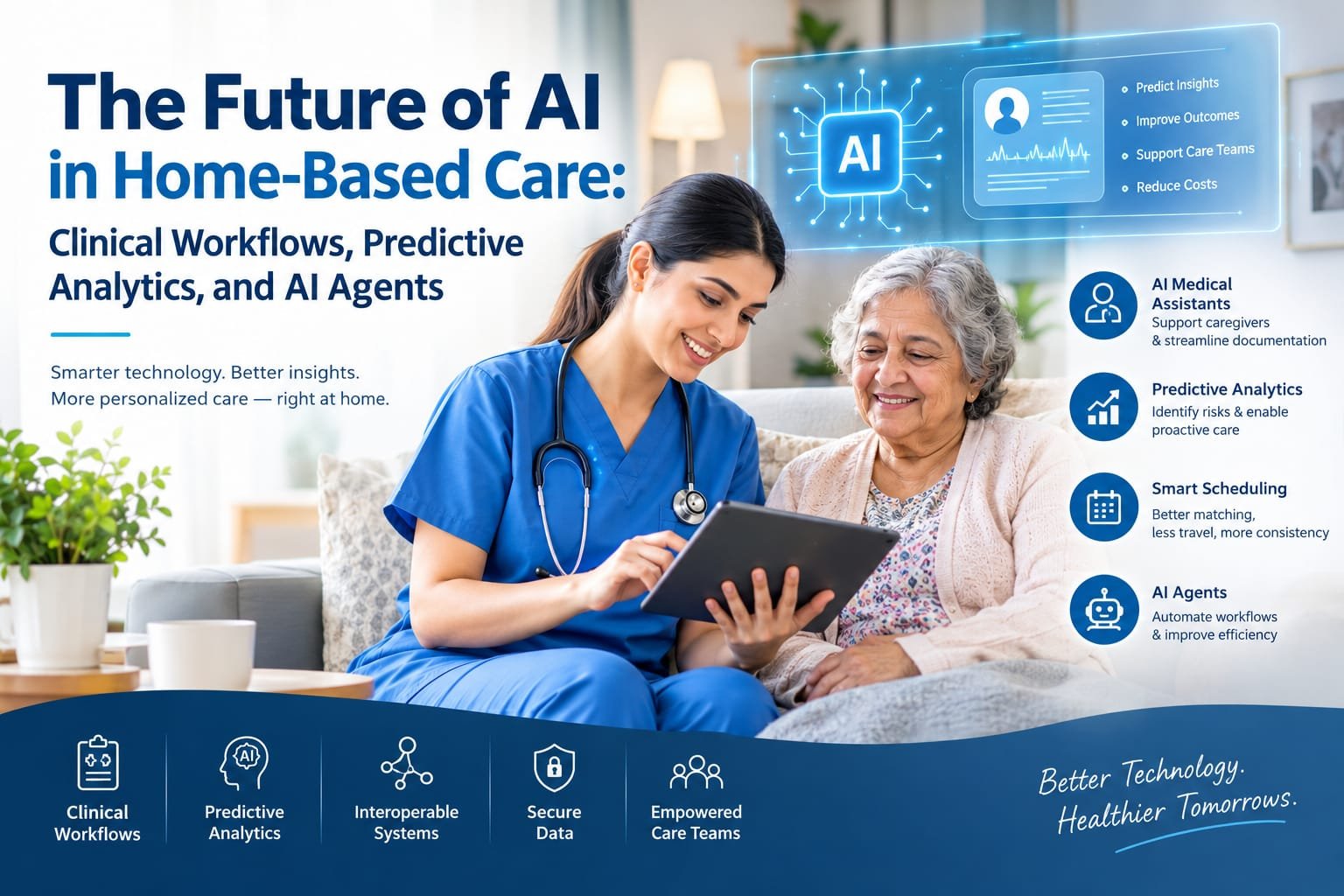
Artificial intelligence (AI) is changing how home-based care providers manage caregivers, coordinate patient visits, analyze clinical information, and control operating costs. From AI-powered medical assistants to predictive analytics, digital health technologies are helping healthcare organizations deliver more personalized and efficient care.
As demand for home healthcare grows, providers need smarter ways to manage clinical operations without compromising patient safety. AI in clinical operations can help reduce administrative workloads, improve scheduling, and support data-driven decisions. However, successful adoption requires reliable data, secure systems, and a clear understanding of where automation adds value.
How AI Is Reshaping Home-Based Care Today
1. Supporting Caregivers With AI Medical Assistants
Caregivers spend considerable time documenting visits, updating patient records, communicating with clinical teams, and completing administrative tasks. An AI medical assistant can help streamline these activities through voice-enabled documentation, automated summaries, and reminders.
For example, an AI assistant can turn visit notes into structured documentation for review by an authorized healthcare professional. These capabilities allow caregivers to spend less time on paperwork and more time supporting patients.
Organizations evaluating AI medical assistants should compare documentation accuracy, integration capabilities, privacy safeguards, and ease of use. The best AI tools for medical students and nursing students may also help future professionals understand clinical documentation and medical terminology, although educational tools should not replace professional supervision or clinical judgment.
2. Turning Patient Data Into Action With Predictive Analytics
Predictive analytics uses historical and real-time information to identify patterns that may indicate changing patient needs. In home-based care, these insights can help teams prioritize follow-ups, identify patients who may need additional support, and allocate resources more effectively.
Applications of AI in clinical operations include identifying missed visits, monitoring changes in patient-reported symptoms, and flagging patterns that warrant clinical review. For organizations operating under value-based care models, value based care AI can support risk stratification and help teams focus resources on patients who may benefit most from proactive interventions.
These systems should support, rather than independently determine, clinical decisions. Predictions must be validated, and clinicians should remain responsible for interpreting alerts and deciding on appropriate care.
3. Improving Travel, Scheduling, and Care Consistency
Travel time and scheduling conflicts can reduce caregiver productivity and disrupt continuity of care. AI-powered scheduling systems can consider caregiver availability, qualifications, patient requirements, travel distances, and visit priorities.
Automated Caregiver Matching and Scheduling
Clinical flow and clinical workflow management software can help coordinate appointments, reduce scheduling gaps, and improve visibility across care teams. AI can recommend suitable caregiver assignments and identify potential conflicts before they affect patients.
Providers can also use automated notifications to communicate schedule changes and remind staff about upcoming visits. Human oversight remains important when matching caregivers with patients who have specialized needs or require particular qualifications.
Future Applications of AI in Home-Based Care
1. Automating Clinical Workflows and Documentation
AI in healthcare tools increasingly supports repetitive administrative work, including visit summaries, referral processing, document classification, and information extraction. Healthcare teams can use automation to reduce duplicate data entry and make relevant information easier to retrieve.
Generative AI data mapping healthcare interoperability solutions can help map information between different systems and formats. When implemented carefully, these solutions may improve data consistency across electronic health records, scheduling platforms, and billing applications.
Organizations should validate extracted information before it enters official patient records and maintain appropriate audit trails.
2. Personalized Care and Proactive Interventions
Digital health technologies can combine patient histories, care plans, assessment results, and caregiver observations to support more personalized services.
For example, an AI system may flag changes in reported mobility, medication adherence, or symptoms for review by a qualified professional. These insights can help care teams decide whether a follow-up assessment or additional support is appropriate.
Real-time AI healthcare finance applications can also help providers connect operational information with financial performance. By understanding staffing costs, missed visits, and service utilization, managers can identify opportunities to improve efficiency while maintaining appropriate care standards.
3. Building Smarter, Connected Healthcare Systems
Disconnected systems create unnecessary work for caregivers and administrators. Integrating scheduling, clinical documentation, communication, and financial reporting can provide a more complete view of operations.
Clinical workflow management software can serve as a central coordination layer, while interoperability tools help exchange information between connected applications. Providers should prioritize secure integrations, appropriate access controls, and reliable data quality before introducing more advanced AI capabilities.
4. Empowering Care Teams With AI Agents
AI agents can perform multi-step administrative tasks within defined permissions. For example, an agent might identify an incomplete visit record, notify the relevant team member, prepare a follow-up task, and update a workflow after receiving authorization.
Unlike a basic chatbot, an AI agent can coordinate actions across connected systems. Nevertheless, sensitive activities such as changing care plans, making clinical decisions, or submitting consequential financial transactions should require suitable validation and human approval.
AI Adoption: From Basic Automation to Strategic Intelligence
Stage 1: Basic Automation
Start with repetitive, low-risk tasks such as appointment reminders, document classification, and routine administrative notifications. Measure time saved, error rates, and staff satisfaction.
Stage 2: Predictive Analytics
Once reliable data is available, introduce forecasting for staffing demand, missed visits, and operational risks. Evaluate model performance regularly and investigate whether predictions are accurate across different patient groups.
Stage 3: Real-Time Decisions With Conversational AI
Conversational AI can help authorized staff retrieve information, summarize records, and navigate workflows using natural language. Systems must respect user permissions and avoid exposing confidential patient information.
Stage 4: AI as a Strategic Business Partner
At a mature stage, AI can support workforce planning, operational forecasting, resource allocation, and performance reporting. Leaders can use these insights to identify bottlenecks and assess opportunities for sustainable growth.
Healthcare organizations can also engage an AI healthcare consultant to evaluate their technology stack, identify suitable use cases, and develop an implementation roadmap. Effective advisory support should connect technical decisions with measurable operational and clinical objectives.
Specialized Opportunities: Medical Billing and Healthcare Finance
Medical billing is another area where automation may deliver measurable value. AI-powered tools can assist with document extraction, coding support, claim checks, and identifying missing information before submission.
Specialized applications include AI-powered hospice billing services, AI medical billing for hospice providers, and AI medical billing for pharmacy operations. These solutions address different billing workflows and should be evaluated according to their specific regulatory, documentation, and reimbursement requirements.
AI in infusion center scheduling can also help coordinate appointments, staffing, and resource availability in complex treatment environments. Providers should assess integration requirements and confirm that any automation follows applicable billing rules and clinical protocols.
Bridging the Gap Between AI Hype and Reality
Despite growing interest in AI, implementation is not automatically successful. Poor data quality, disconnected applications, staff resistance, privacy risks, and unrealistic expectations can limit results.
Before deploying a new solution, organizations should define the problem, establish baseline performance, run a controlled pilot, and measure outcomes. Useful metrics include documentation time, scheduling efficiency, claim error rates, caregiver utilization, and patient experience.
Leaders researching questions about AI in healthcare should also distinguish between demonstrated capabilities and vendor claims. AI product research tools for health, wellness, and pain relief can help teams explore the market, but product claims require independent verification. Similarly, healthcare AI tools should undergo appropriate security, performance, and clinical validation before broad deployment.
Partnering for a Smarter Future
Successful AI adoption combines technology, clinical expertise, operational knowledge, and change management. An experienced implementation partner can help providers assess workflows, select suitable tools, integrate existing systems, and train staff.
The goal is not to automate every interaction. It is to remove avoidable administrative friction, support better decisions, and give care teams more time to focus on patients.
Common Questions About AI in Home-Based Care
What are the main benefits of AI in home healthcare?
AI can support scheduling, documentation, predictive analytics, administrative automation, and operational reporting. Benefits depend on implementation quality, data reliability, and staff adoption.
What is the best AI for medical students and nursing students?
The right tool depends on whether the goal is research, study support, clinical terminology, or documentation practice. Students should verify information against trusted educational and clinical sources and follow their institution's rules.
Can AI improve hospice and pharmacy billing?
AI can assist with extracting information, checking documents for missing details, and supporting billing workflows. Qualified staff must verify coding, documentation, and claim compliance.
How should a home healthcare provider start using AI?
Begin with a well-defined, low-risk workflow. Establish baseline metrics, test a suitable solution with a small team, assess privacy and integration requirements, and expand only when results justify it.
Insights for Home-Based Care Leaders
AI is becoming an important component of modern home healthcare operations. Providers that combine clinical workflow management software, predictive analytics, connected systems, and carefully governed AI agents can build more responsive and efficient services.
The strongest strategy starts with practical problems, measurable outcomes, and patient-centered implementation. By adopting AI progressively, home-based care leaders can improve operational visibility, support their workforce, and protect financial sustainability while keeping quality of care at the center of every decision



Comments (0)