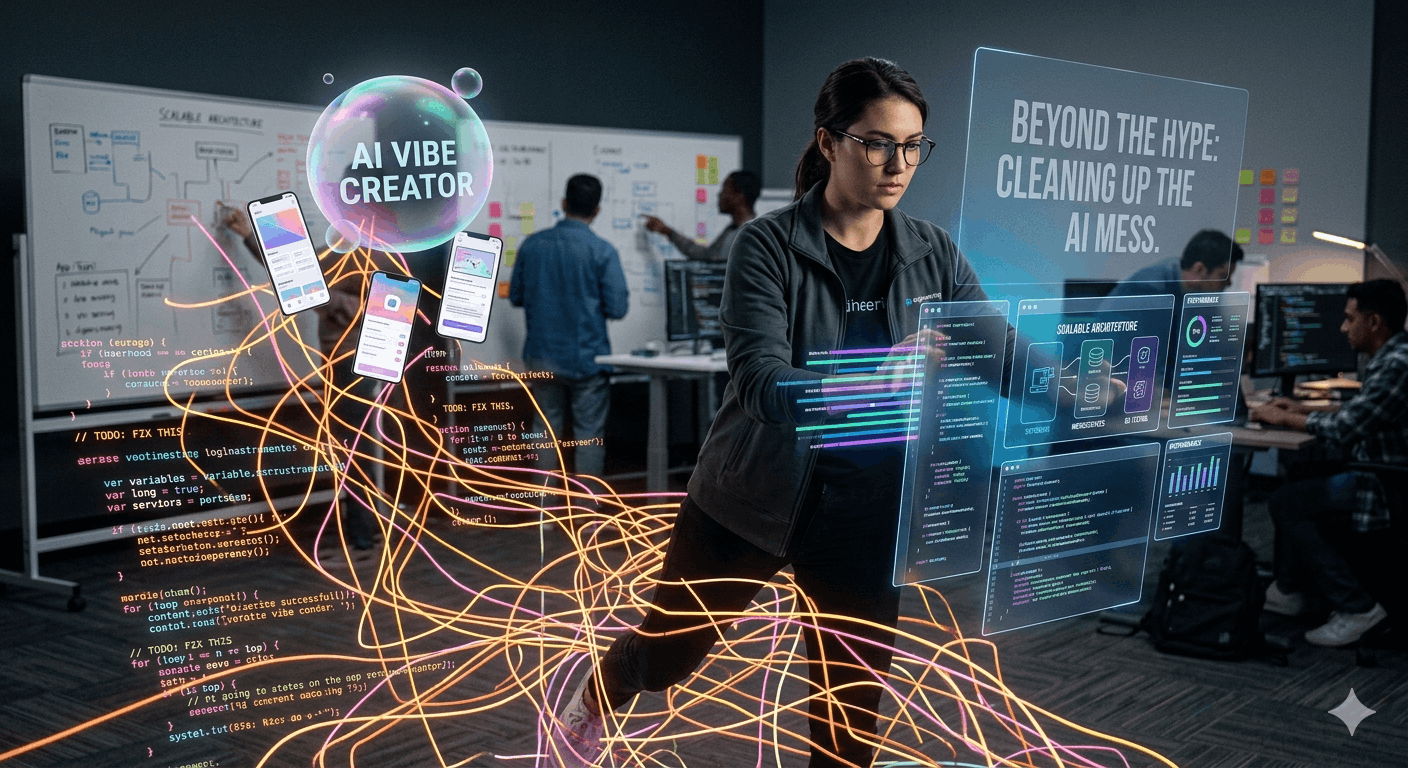
Beyond the Hype: Why "Vibe Coding" is Creating a Massive Demand for Real Engineers
We’ve all seen the videos. Someone with zero coding experience prompts a Large Language Model (LLM) for 45 minutes and walks away with a fully functioning web application. It’s an incredible time to be alive, and it has given rise to a new phenomenon: vibe coding.
But while building a prototype on pure vibes is easier than ever, taking that application to production is an entirely different story.
As the initial shockwave of generative AI settles, a glaring reality is hitting the tech industry: AI tools are producing an exponential amount of unoptimized code, messy architectures, and skyrocketing API bills.
If you are a developer worried that AI is going to take your job, take a deep breath. The landscape isn’t shrinking; it’s shifting. Here is why the era of vibe coding is actually your biggest career opportunity.
The Rise of "AI Slop" and the Clean-Up Crew
Vibe coding is fantastic for rapid prototyping. You can spin up a front-end with Tailwind CSS and attach it to a quick backend database in minutes. However, LLMs don't inherently understand your long-term business goals, scalability constraints, or complex database requirements.
This has led to a massive influx of what engineers call "AI slop"—applications that look great on the surface but are fundamentally broken under the hood. Freelance platforms like Upwork are already seeing a surge in a brand-new job category: "I vibe-coded this app, it’s a complete mess, please fix it."
As an engineer, your value is rapidly shifting from writing code to quality control, architecture, and deployment. AI can generate lines of code, but it still struggles to register applications across Apple and Android stores, handle complex Docker deployments, or maintain strict quality assurance (QA).
Shift Your Focus from Prompt Engineering to Context Engineering
For the past couple of years, "prompt engineering" was hailed as the ultimate skill of the future. The truth? Basic prompting is mostly hype. The real discipline moving forward is context engineering.
When building production-ready AI applications, simply dumping data into an LLM creates a massive problem: exorbitant API costs. If you rely on agentic workflows that loop repeatedly, a simple automated task can easily rack up an $80 bill in a single morning.
Context engineering focuses on:
-
Context Pruning & Summarization: Cleaning up the data sent to the model so you aren't wasting tokens.
-
Token Optimization: Ensuring the LLM delivers maximum business value per word.
-
Hybrid Architectures: Knowing when not to use generative AI.
The Sword vs. The Knife: Generative AI is a shiny, powerful tool, but you don't use a broadsword to chop an apple. Seasoned engineers know how to dissect a problem—using lightweight, cost-effective rule-based systems or traditional statistical machine learning for 80% of the app, and reserving expensive LLMs only for the pieces that genuinely require language generation.
The New Roadmap for Modern Engineers
If you are a student, a recent graduate, or a developer looking to stay ahead of the curve, your technical roadmap needs an upgrade.
[Core Fundamentals] ➔ [AI Tool Mastery] ➔ [Soft Skills & Branding] (Python, Data Structures) (LLMs, Vector DBs) (Communication, Business ROI)
-
Master the Fundamentals: Don't treat AI as a complete black box. Big tech interviews at companies like Stripe or Coinbase still test for core fundamentals. If your AI tool writes a complex algorithm and it breaks in production, you have to be the one who understands the data structures well enough to refactor it.
-
Learn Business Integration: The "brilliant but isolated" programmer who sits in a corner writing pure C++ without talking to anyone is facing direct competition from models like Claude Opus. To stand out, you must be able to talk to clients, understand business ROI (Return on Investment), and translate real-world problems into technical systems.
-
Build Your Personal Brand: In an era where code is cheap, trust is the ultimate currency. Clients and tech leads don't just want the cheapest code—they want to work with people they trust. Visibility, clear documentation, and a strong professional profile are what will keep you in high demand.
Final Thoughts
AI is not replacing engineers; it is augmenting them. Think of yourself less like a traditional keyboard typist and more like Iron Man. The suit (AI) gives you incredible speed and power, but without the pilot (your engineering brain, architectural knowledge, and human intuition), the suit is just a heavy piece of metal.
Stop just vibe coding. Start engineering.



Comments (0)